Something Playful: The Chalk Edit
Age by Age: What to Expect/ The Setup/ Chalk Paint/ When It’s Not Working/ Favorite add-ons for building out your chalk supply
My son was maybe two and a half, crouched at the bottom of our driveway with a fat piece of yellow chalk, making a ”road,” really just a wobbly line that zigzagged between cracks in the pavement. He had a Matchbox car in his other hand, and he was completely in it. Making car noises under his breath, driving his car down the path he’d made, stopping to add a new turn when he felt like it.
I stood at the top of the driveway, rhythmically shifting my weight from hip to hip as I lulled my newborn to sleep in the sling and watched him out of the corner of my eye. He didn’t need me to hover. He didn’t want me to play with him. The chalk and the pavement and the car in his hand were all he needed in that moment.
That’s the thing about chalk that gets overlooked: it hands control to kids in a way that almost nothing else does.
You don’t need an elaborate setup, you don’t need lots of time or supervision. There is no finished product to aim for. You give children chalk and the freedom to create, and the outcome will be different for everyone.
From toddlers through teens and even adults, chalk can be the material that adds play and whimsy to your Spring and Summer. Keep reading, and I’ll tell you all the wonderful ways we’ve used this simple material over the past eighteen years.
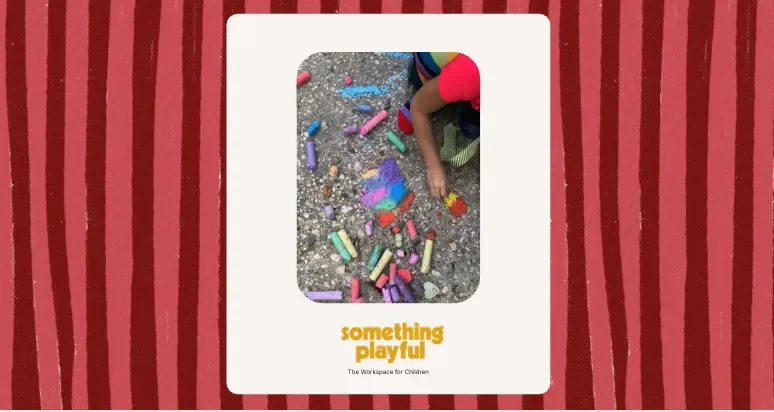
This is week 5 of Something Playful. Over the past few weeks, I’ve been going one material at a time — playdough, board games, magnetic tiles, bath toys — showing you how to use what you already have at home to get more independent play out of each one. This week: chalk.

Why Chalk
Chalk costs almost nothing. It works outside. It requires zero setup and zero adult involvement. And it erases itself with rain, a hose, or a wet rag.
But the reason I want to talk about chalk isn’t just that it’s cheap and easy. It’s that kids can do interesting, important things with it completely on their own.
It’s forgiving. There are no mistakes with chalk. Don’t like what you made? Scuff it with your shoe. Start over. The pressure is gone before it ever arrives.
It’s big. Chalk invites movement like whole-arm scribbles, running and drawing, sprawling across the driveway. That bigness matters, especially for younger kids whose fine motor isn’t there yet.
For years, my own three kids spent hours trying to invent a way to attach chalk to their scooters and bikes so that they could draw as they moved. Sometimes they color the wheels, sometimes they’d make elaborate contraptions that towed a long stick with wet chalk duct taped to it. The joy was in the making. They reworked their ideas for years.
Chalk belongs to kids from the start. You’re not setting up an activity. You’re not hovering. You hand it over, and they take it from there.
The Setup: Less Is More
Here’s what doesn’t work: a brand-new 64-piece bucket dumped out on the driveway with chalk stencils and instructions to “go draw something.”
Too many choices. No entry point. They poke around for a minute, and then they’re done.
Here’s what does work:
The rest is for my paid subs. Not sure if you want to become a paid sub? Use this 7-day free trial on me.