Something Playful: The Loose Parts Edit
The Setup/ Four Ways to Put It Out/ Age by Age: What to Expect/ Storage and Rotation/ The Independence Move/ When It’s Not Working/ The Loose Parts List
A picture popped up in my Facebook memories the other day. It’s Ruby, now 16, at three years old. She’s laying on the kitchen floor, still in her outfit from preschool that day, leaning over a bowl of pearly pink beads and a piece of round styrofoam I’d stuck some toothpicks into.
The image stopped me cold. I remember it like it was yesterday. I was pregnant with Sloane, and bone tired. I felt guilty that she’d been watching so much TV while Nate was off at kindergarten, and when I came across this little bag of beads from the dollar store, I thought, why not? She loved pink. I mean REALLY loved pink, in the way that only three year olds can commit to a color.
I put the beads and tray on the floor, put on some music, and plopped down on the couch with a cup of tea and a book.
One by one, she started carefully stacking the beads onto the toothpicks. She was humming songs from preschool that I didn’t know the words to. Eventually, she moved across the room and played with her dolls, she did a puzzle, and then she came back to the beads.
Before we left to pick up Nate from kindergarten, she carefully lifted her beads to the kitchen table. “I’m gonna show this to Nate-Nate,” she told me, grinning through a mouthful of Pirate’s Booty.
A bowl of beads, a few toothpicks, a piece of styrofoam, on the kitchen floor, was all it took to get her started playing independently. Well, that, and having me nearby. (More on that here)
Think about the last time you went to the diner as a family. Did your kids line the sugar packets up in a pattern and stack the little plastic jelly tubs while they waited for chocolate chip pancakes?
Think about the last time you went to the beach. Did they gather shells or pebbles and make them into a game? Maybe they pulled a few cans out of the recycling to build with before you could stop them.
That’s loose parts play, guys. It’s really as simple as that.
I’ve been promising this loose parts edit for weeks, but I couldn’t deliver because every version I wrote felt like I was overcomplicating things. So, I’ve decided that I’m not going to walk you all the way back to the seventies when the theory of loose parts play was first introduced. I am fascinated by the evolution, but you guys just really want to get your kids playing with loose parts. I’ll skip the theories and history and break it down for you by age and stage. I’ll tell you exactly what to put out, how much, and what to do when it stops working. Let’s do this.
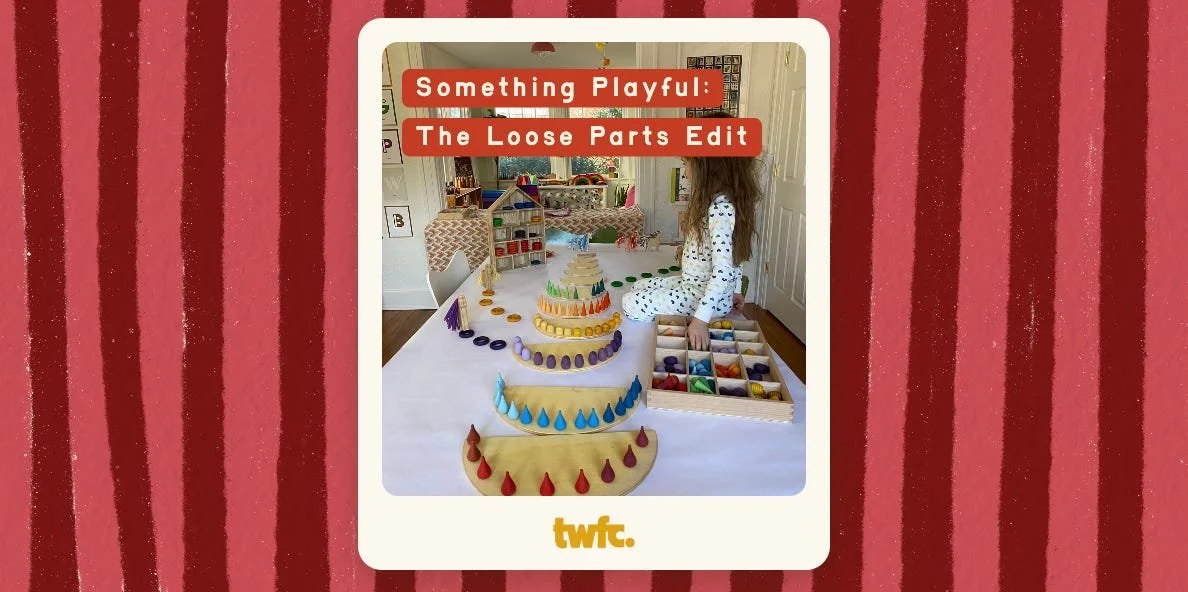
Loose parts are a collection of objects with no fixed purpose. They can be open ended toys and they can also be bottle caps, stones, buttons, rings, discs, spools, shells, pink beads. There is no correct way for your kids to play with them, you don’t need to “set it up right.”
Most, not all, of the coffee table toys I recommend are loose parts.
If you set up the tinker tray from the playdough edit, that was loose parts play.

Why Loose Parts
My kids have played with the same wooden loose parts for eight years. The little wooden shapes have been food, money, building materials, whatever the game needed that day. That’s the test of a good loose part: it does not do anything until someone gives it a role.
Loose parts span ages and stages, and are great in a home with multiple kids. The same tray of cubes is a stack and knock over game for a toddler, pretend money for a preschooler, and a parking garage for cars for your first grader.
Loose parts are trending, but don’t search the hashtag because you will be buried in gorgeous, expensive, handmade wooden sets and the pressure to buy. You do not need all of it. You might not need any of it… I beg you to start slow, start small, start with found objects.
We spent years playing with saved bottle caps, dollar store jumbo buttons, and beach stones the kids painted themselves. They played just as hard with stuff from the recycling bin as they did with the beautiful wooden rings and the cubes purchased off of Etsy.
Focus more on making loose parts accessible and less on how expensive the toy is.
Below: four ways I set loose parts out so they get used instead of shoved to the bottom of a bin and spread across the house, what to put out at every age starting with your toddler, how to store and rotate them, what to do when it’s not working, and the loose parts list, from your recycling bin to the splurge.
Something Playful is a paid series inside this publication. Each installment takes one type of play material (playdough, magnetic tiles, art supplies, sensory toys, chalk, stickers, and more) and tells you exactly what to put out, how much, and what to do when it stops working. Age-by-age.
If you have been thinking about subscribing, this is a good week to start. Use this 7-day free trial on me. (The rest is for my paid subs...)