I Stopped Making My Kids Clean Up Every Day... They Started Playing More
The time I freaked out about Legos/ Cleanup expectations by age/ The reset that lets them leave their play up/ When I just clean up for them
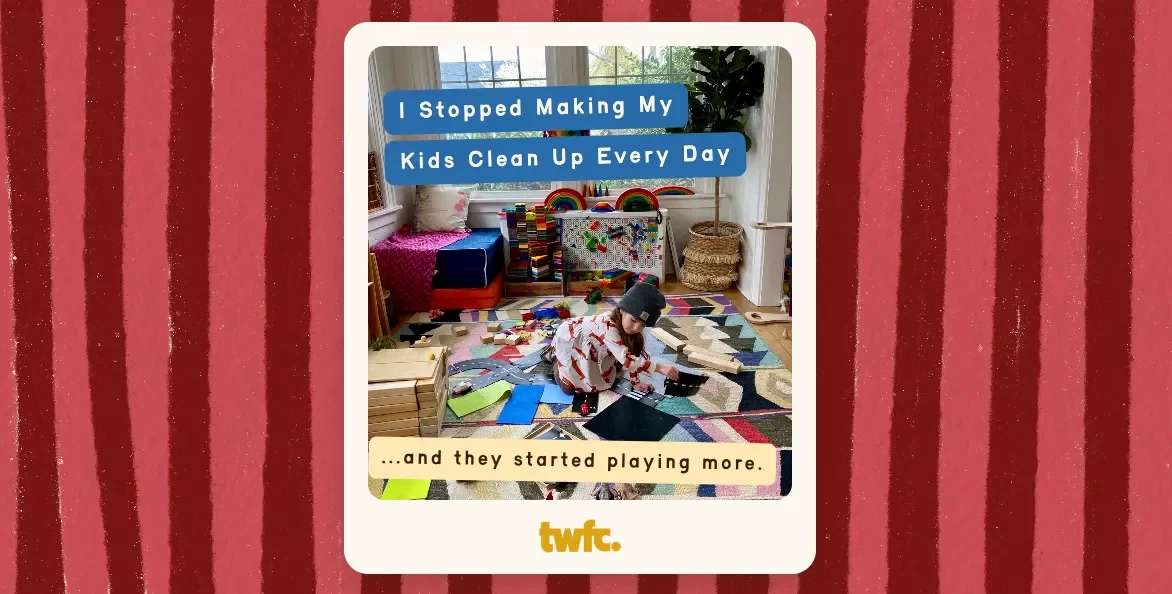
It was a regular Sunday afternoon in 2017. My oldest was nine years old and obsessed with Legos. His entire room was wall-to-wall loose bricks, Lego fire trucks, Lego police cars and airplanes, and a Lego airport that was doubling in size by the hour. The top of his dresser was spilling over with a display of his creations. Under his bed were bins and bins of bricks. Lego was… everywhere.
If you know me, you know I am a lover of all things play. And with that, I have grown my tolerance for the mess that solid play sessions inevitably create. But on this particular Sunday? I was stressed.
My girls had been taking turns passing a cold back and forth, which meant there hadn’t been a week in ages when all three kids had been fever-free and at school.
I entered his room with a full basket of clean and folded laundry, ready to be placed neatly in his drawers, when I stepped on a small, yellow, SHARP Lego, and I just about lost my ever-loving mind on my sweet, unsuspecting boy.
“I’m never buying another Lego set again! This is insane. I cannot with this mess. I can’t even get to your drawers to put away the laundry...”
But then I looked down at his mop of brown hair and big, wide eyes.
“Mom, I’m building a sorting factory. Watch this!”
He scooted across the room on a belly scooter, with a handful of bricks, dropping each one by shape into box tops, complete with labels he’d made out of scraps of paper, tape, and his scrawny, little-boy handwriting.
I felt like such a jerk. I’d completely lost the plot.
The Legos weren’t the problem. I was.
My overwhelm and my adult stressors were clouding out the fact that deep, rich play tends to be messy, chaotic even. Because when kids are playing, they aren’t thinking about whether or not they are creating a mess. They are thinking about their own ability to create a world that matters to them. And that’s exactly what builds confidence, executive function, and a sense of self.
This is the part where most parenting experts say something like, “Embrace the chaos! Your kids are only little once. One day you’ll miss the mess!”
But I am not them, and I know that it’s not helpful to hear that you need to “just roll with it” when you are drowning.
Just because you love play doesn’t mean you need to live in a mess. This is your home, and you get to decide how you want it to feel and how things work inside of it. So please, don’t feel guilty setting limits around cleanup time.
Inside This Post:
Why cleanup turns into a battle of the wills
Crew Chief to Consultant: cleanup by age
The sorter and the putter-awayer
Reset the mess, not the play (the change that got my kids playing more)
Why sometimes I clean up for my kids instead of telling them to do it
What’s Really Happening When Cleanup Time Turns Into a Battle of the Wills?
Let’s start with the obvious: No one likes to clean up. And for kids, it means stop doing the thing you love and start doing the thing that feels overwhelming and unfun.
Let me break it down for you. It's hard for kids to see the whole picture. You walk in and think, "Oh, just put the blocks away." They walk in and see 147 individual items with no clear starting point. Knowing what "belongs together" is tricky too. Adult brains automatically sort things into groups (all the art supplies, all the dress-up clothes). Kid brains? Not yet. We have to teach them. And "clean up your toys" sounds simple to us, but to them it's: figure out what needs cleaning, decide where it goes, move it there, remember what you were doing, and repeat 50 times.
This is why the “just clean your room” approach fails. We’re asking them to do something they probably cannot do. But here’s the good news: once you understand what they CAN do at each age, cleanup becomes collaborative instead of combative.
If cleanup feels like too much for them and for you, the next part walks you through what works at each age and how to make it easier on everyone.
This part is for paid subscribers. 👇
Not sure if a paid subscription is for you? Use this free seven day trial to pass the paywall and unlock my entire archive. Poke around, I think you’re going to like it here.