From Toddlers to Teens: 27 Screen-Free Games That Build Connection
Board Games, Card Games & Strategy Games by Age Group
Games aren’t just entertainment. They give kids a way to connect, belong, laugh, and reset without the pressure of being perfect.
This guide features games organized by age, from toddlers learning cause and effect to teens who need complex strategy and social dynamics. Start simple. Add slowly. The best game is the one your family actually plays.
*This post contains affiliate links. I may earn a small commission if you purchase through my links, at no extra cost to you. I only recommend things I truly stand behind.
WHAT CAN I HELP YOU FIND?Toddlers (18 months to 3 years)
Preschoolers & Kindergarten (3 to 5 years)
Early Grade School (6 to 8 years)
Middle Grade School (9 to 12 years)
Tweens & Teens (13+ years)

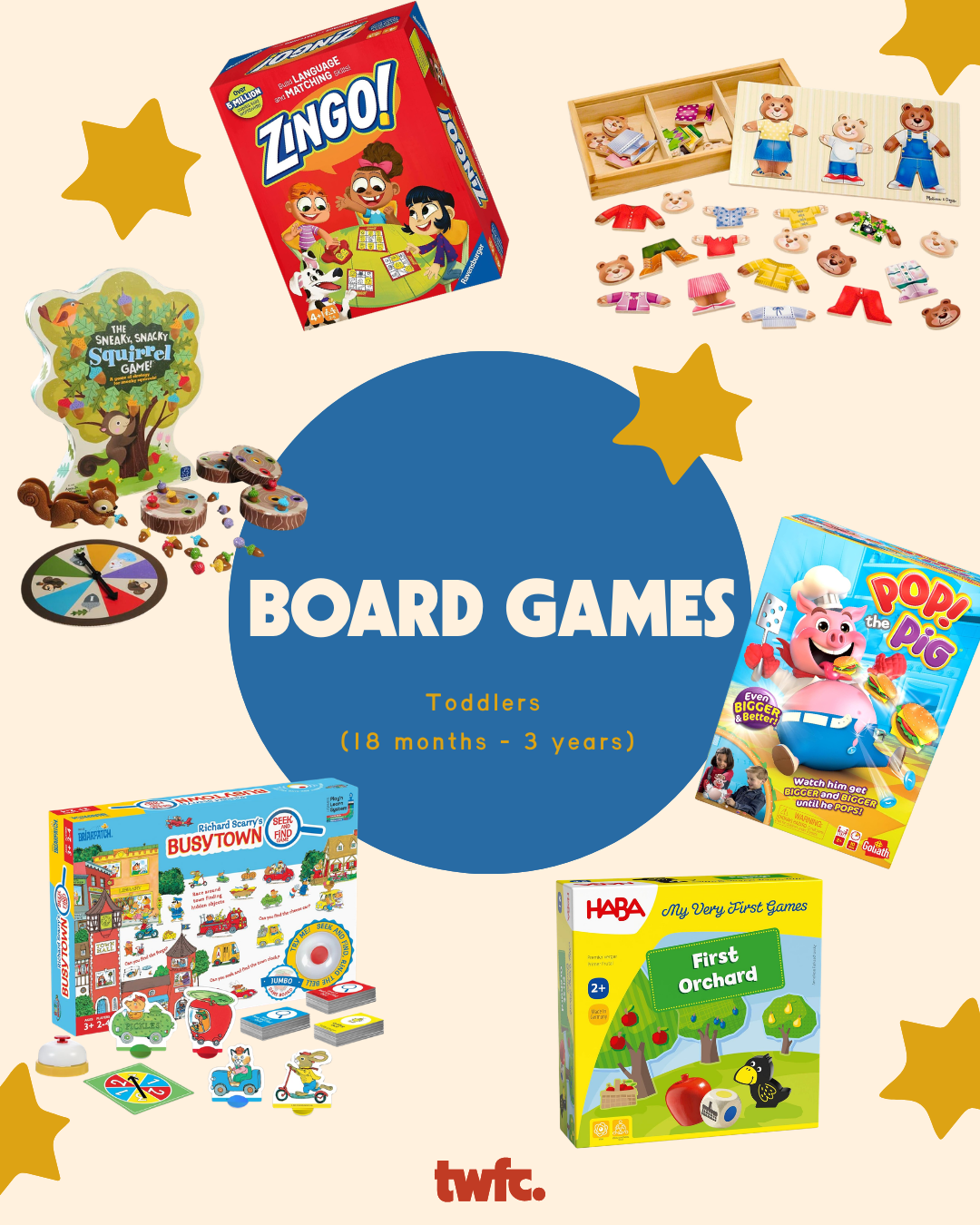
Toddlers (18 months to 3 years)
Focus On: Cause and effect, turn taking, simple matching, gross motor skills
Short attention spans need immediate gratification. Games should be light and cooperative rather than competitive, with clear cause and effect relationships.
Cooperative fruit picking game that teaches colors and working together.
Why I chose it: No winners, no losers. Just kids working together to pick fruit before the raven arrives. Toddlers learn colors, turn-taking, and teamwork without the emotional weight of competition. It’s gentle and satisfying.
2. Sneaky, Snacky Squirrel Game
Simple color matching with chunky tweezers for fine motor development.
Why I chose it: Match colors, practice pincer grasp, while having fun.
A long cooperative board with searching and finding.
Why I chose it: This was a favorite in our house. The board is massive, which keeps toddlers interested longer than you’d expect. Everyone searches together, no one gets eliminated.
4. Pop the Pig
Push your luck game with silly outcomes that build anticipation.
Why I chose it: Toddlers love cause and effect. Feed the pig, watch his belly grow, wait for the pop. It’s silly, it’s suspenseful, and it teaches patience in the most entertaining way possible.
5. Zingo
Bingo with pictures instead of numbers.
Why I chose it: Simpler than regular bingo, for toddlers who can’t read yet. The slider mechanism adds a tactile element that keeps little hands busy. Great for matching and recognition.
6. Simple Puzzles (4 to 12 pieces)
Spatial reasoning and persistence.
Why I chose it: Puzzles are focused work. Keep a few on rotation and watch them return to the challenge over and over.

Preschoolers & Kindergarten (3 to 5 years)
Focus On: Following rules, basic strategy, emotional regulation, fun, and social skills
Simple rules and short term strategy. Preschoolers are beginning to understand winning and losing, but still need games that don’t eliminate players and lots of practice with both outcomes.
7. Candy Land
Classic pathway game for counting and color recognition.
Why I chose it: A rite of passage. No reading required, just matching colors and moving spaces. It’s simple enough for a 3 year old to grasp and nostalgic enough that adults don’t mind playing it a hundred times.
Introduces consequences and recovery from setbacks.
Why I chose it: Life has ups and downs. This game teaches that in the safest possible way. You climb a ladder, you slide down a chute, you keep going.
Counting and basic addition and subtraction.
Why I chose it: Picking cherries, counting them into the bucket, losing some when the spinner says so. It’s number sense in action, wrapped up in a fruit-picking game.
Pattern recognition and strategic thinking.
Why I chose it: Matching cards to the board teaches visual discrimination and planning ahead. Kids start to see patterns, anticipate moves, and think one step beyond their turn.
Based on a beloved character, teaches problem-solving.
Why I chose it: If your kid already loves Pete the Cat books, this game is an easy win.
12. Hoot Owl Hoot
Cooperative game about getting owls home before sunrise.
Why I chose it: Another no-losers game. Kids work together, which means less tears and more teamwork.
13. Sleeping Queens
A simple card game with basic math and strategy.
Why I chose it: Fast, portable, and surprisingly engaging.
Looking for more on board games?
Click below for the difference between family game nights that work and those that end in tears/what to do when losing feels like the end of the world/how to deal when it’s not working
Early Grade School (6 to 8 years)
Focus On: Complex rules, strategic thinking, handling competition, and mathematical concepts
Around six to eight years old, kids can typically handle more complex rules and longer games. They’re developing the ability to think ahead and plan a strategy. Some kids are beginning to enjoy direct competition.
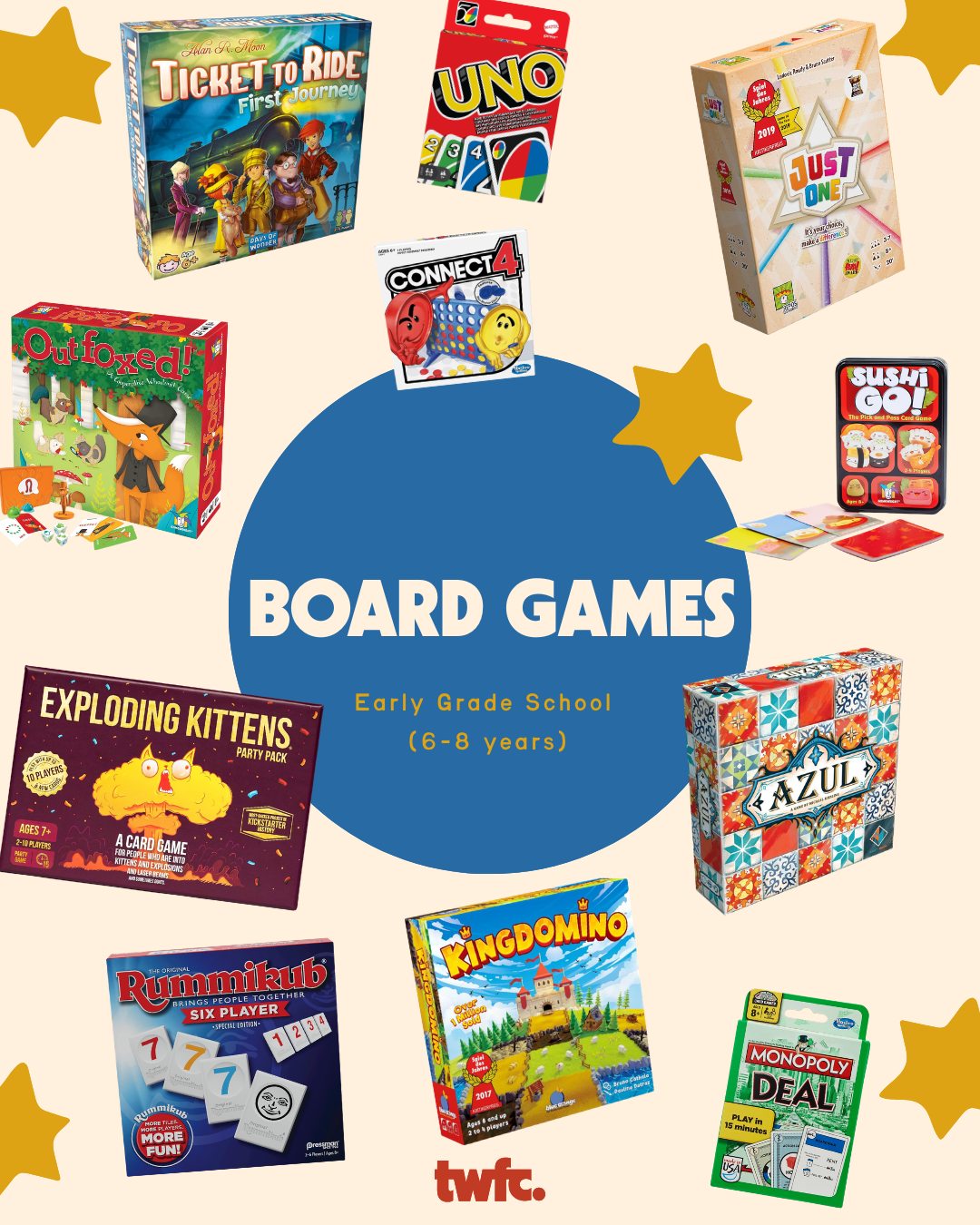
14. Ticket to Ride: First Journey
Route building with geography learning.
Why I chose it: A simplified version of the classic that introduces kids to route planning and map reading.
15. Azul
Pattern recognition and spatial planning.
Why I chose it: Beautiful, tactile, and deeply satisfying. Kids arrange tiles into patterns, which teaches spatial reasoning and planning. It’s the kind of game that holds up even as they get older.
Quick card game with silly theme.
Why I chose it: Fast, funny, and strategic. Kids love the absurd humor and the tension of not knowing when the kitten will explode. It teaches risk assessment in the most ridiculous way possible.
17. Just One
Cooperative word guessing game.
Why I chose it: Everyone works together to help one player guess a word by giving one word clues. It teaches vocabulary, creative thinking, and collaboration. No competition, just collective problem solving.
18. Kingdomino
Tile laying kingdom building.
Why I chose it: Kids build their own kingdoms by matching terrain tiles. It’s part puzzle, part strategy, and entirely engaging. Teaches spatial reasoning and planning without feeling like homework.
19. Sushi Go!
Drafting game with cute art and quick play.
Why I chose it: Adorable, fast, and surprisingly strategic. Kids draft cards, make decisions, and score points. The rounds move quickly, which keeps attention high and frustration low.
20. Outfoxed
Cooperative mystery-solving game.
Why I chose it: A whodunit for kids. Everyone works together to solve the mystery before the fox escapes.\
21. Monopoly Deal
A faster card version of the classic property game.
Why I chose it: All the property collecting, none of the three hour marathon.
22. UNO
Classic card matching with strategy elements.
Why I chose it: Simple enough for a 6-year-old, strategic enough for adults.
23. Connect 4
Strategic two-player game.
Why I chose it: Quick, competitive, and deeply satisfying when you get four in a row.
24. Rummikub
Our personal family favorite.
Why I chose it: This is the game my husband’s family played constantly. It’s part rummy, part strategy, and entirely addictive. Kids learn number patterns, sequencing, and flexible thinking. And yes, it’s challenging enough that adults genuinely enjoy playing.
Middle Grade School (9 to 12 years)
Focus On: Advanced strategy, problem solving, social negotiation, abstract concepts
They can handle longer games (45 to 60 minutes), more complex strategies, and social dynamics like trading and negotiation. They’re beginning to enjoy games that require planning multiple turns ahead.
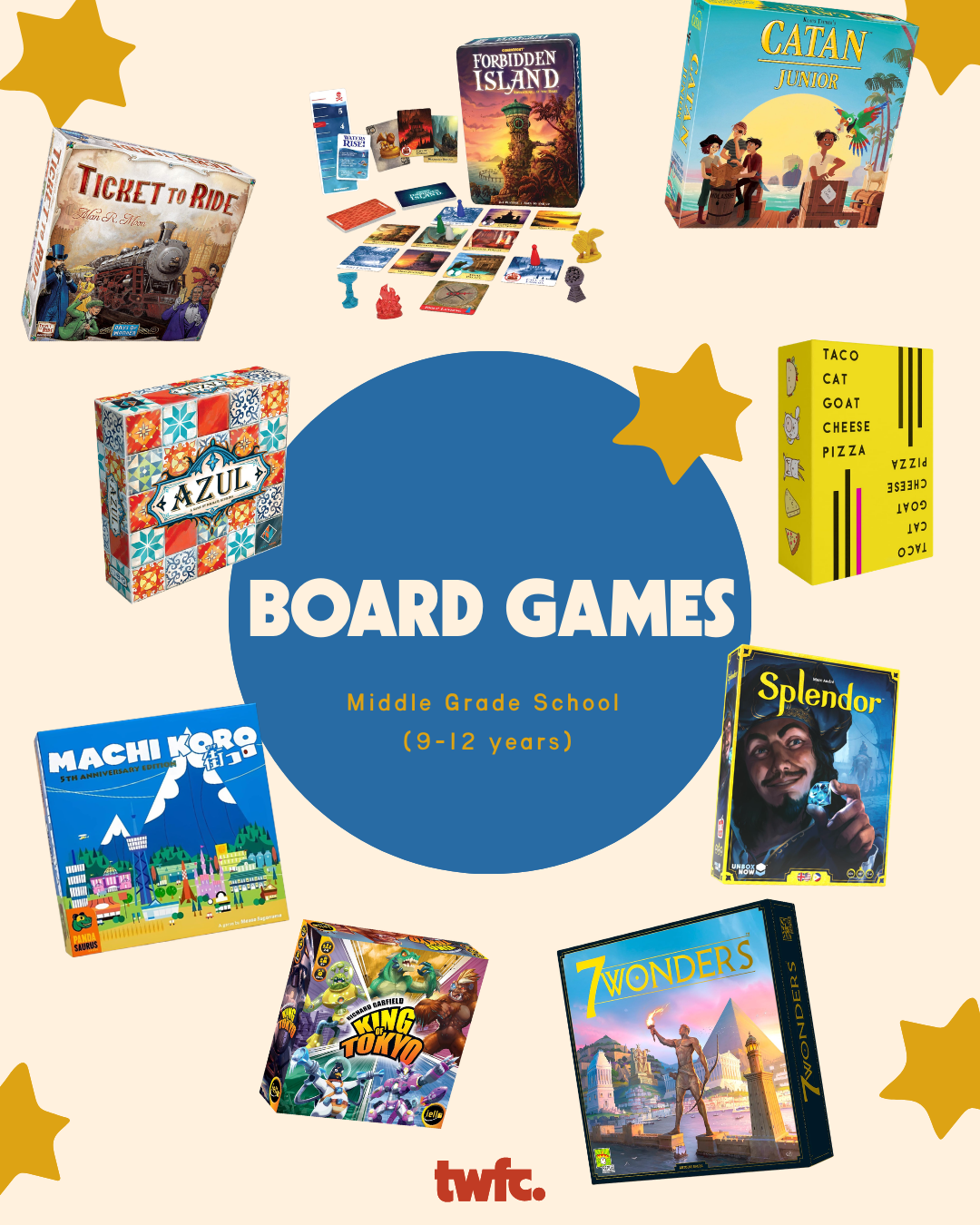
25. Ticket to Ride (full version)
Full version with route planning and blocking.
Why I chose it: Full disclosure, my husband and daughter love this game and it is too hard for me to follow. But for kids who love maps, trains, and planning, this is the gold standard. It teaches geography, resource management, and long term strategy.
26. Splendor
Engine building with resource management.
Why I chose it: Collect gems, buy cards, build your engine. It’s elegant, strategic, and teaches resource management without being dry. Kids learn to plan ahead and optimize their turns.
27. Catan Junior
Simplified island building and trading.
Why I chose it: A gentler introduction to Catan. Kids build, trade, and strategize without the full complexity of the adult version. It’s a gateway game to more advanced strategy.
28. King of Tokyo
Dice rolling monster game with risk and reward decisions.
Why I chose it: You’re a monster fighting for control of Tokyo. The dice rolling adds luck, but the decisions add strategy. Kids learn probability and risk assessment while pretending to be giant creatures.
29. Machi Koro
City building with dice and strategy.
Why I chose it: Roll dice, earn coins, build your city. It’s part luck, part strategy, and entirely engaging. Kids learn resource management and planning in a game that moves quickly.
30. Azul (listed again for middle grade)
Beautiful tile laying with a deeper strategy than the younger versions.
Why I chose it: This game grows with kids. What felt like simple pattern matching at 6 becomes complex spatial planning at 10. Same game, deeper thinking.
31. Taco Cat Goat Cheese Pizza
Fast paced reaction game.
Why I chose it: It’s fast, chaotic, and hilarious. No strategy, just reflexes and joy.
32. Forbidden Island
Cooperative treasure hunting adventure.
Why I chose it: The island is sinking and you’re trying to collect treasures before it’s too late. Kids work together, plan strategically, and make high stakes decisions. It’s tense, cooperative, and genuinely fun.
33. 7 Wonders
Civilization building (with help from reading cards).
Why I chose it: Kids build civilizations, manage resources, and plan for the long game. It’s complex, but with a little help reading cards, they grasp the strategy quickly. Teaches planning and resource management.
34. Clue
Classic deduction and logic game.
Why I chose it: Who did it, where, and with what weapon? Kids learn deductive reasoning by eliminating possibilities and tracking information.
35. Yahtzee
Probability and decision making with dice.
Why I chose it: Roll dice, decide what to keep, score strategically. It teaches probability, risk assessment, and decision making under uncertainty. Simple rules, endless strategy.
36. Phase 10
Multi round card game requiring planning.
Why I chose it: Complete phases, score points, and outlast your opponents. It’s part rummy, part strategy, and requires planning across multiple rounds.
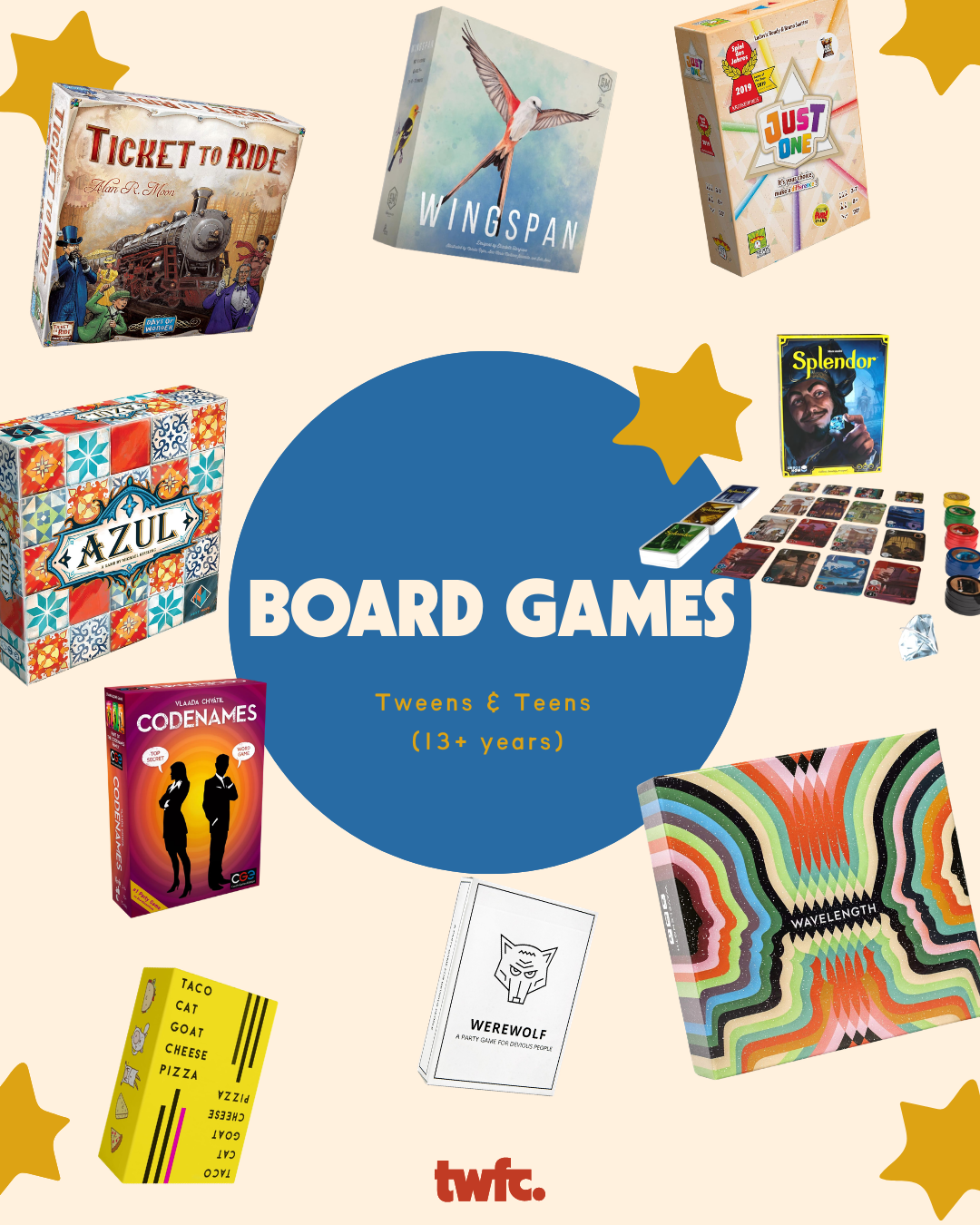
Tweens & Teens (13+ years)
Focus On: Complex strategy, social dynamics, abstract thinking, identity formation
Complex rules, multiple strategies, and social dynamics. Games become tools for identity expression and peer bonding.
Quick & Social Games
37. Taco Cat Goat Cheese Pizza
Fast-paced reaction game.
Why I chose it: It’s the kind of game teens actually want to play. Fast, silly, and zero pressure.
38. Wavelength
Team-based guessing game about concepts.
Why I chose it: One player gives a clue on a spectrum (like “cold to hot”) and teammates guess where it falls.
39. Telestrations
Drawing and guessing game (like telephone with pictures).
Why I chose it: Telephone meets Pictionary.
40. Codenames
Word-based team game requiring abstract thinking.
Why I chose it: Give one-word clues to connect multiple words on the board. It’s about making connections, thinking abstractly, and reading your teammates. Strategic and social at the same time.
41. Just One (listed again for teens)
Cooperative word game that scales well.
Why I chose it: Still works beautifully for teens. The cooperative element removes competition and the word guessing keeps everyone engaged. Simple rules, sophisticated thinking.
Strategy Games
42. Ticket to Ride (listed again for teens)
Route building across maps.
Why I chose it: Still a favorite for teens who love maps, planning, and long term strategy. The full version offers enough complexity to keep older kids engaged for the long haul.
43. Splendor (listed again for teens)
Engine building with gems.
Why I chose it: Elegant, strategic, and satisfying. Teens appreciate the efficiency of the game design and the depth of strategy packed into such simple rules.
44. Azul (listed again for teens)
Beautiful tile laying game.
Why I chose it: A game that grows with kids all the way into the teen years. What started as color matching becomes complex spatial planning and risk assessment. Same tiles, deeper strategy.
45. Catan
Resource management and trading.
Why I chose it: The full version. Build settlements, trade resources, negotiate with opponents. It’s the classic strategy game for a reason. Teens learn negotiation, resource management, and long term planning.
46. Wingspan
Bird themed engine builder.
Why I chose it: Gorgeous, strategic, and surprisingly calming. Collect birds, build your engine, score points. It’s the kind of game that appeals to teens who want depth without chaos.
Party & Group Games
47. Werewolf/Mafia
Social deduction and bluffing.
Why I chose it: Teens love the social intrigue. Figure out who’s lying, who’s telling the truth, and survive the night. It’s drama, strategy, and social dynamics all in one.
48. Spyfall
Location guessing game with hidden roles.
Why I chose it: Everyone’s at the same location except one spy. Ask questions, figure out who doesn’t belong, don’t reveal too much. It’s all about reading people and staying cool under pressure.
50. Dixit
Creative storytelling with beautiful art.
Why I chose it: Give cryptic clues based on surreal artwork. Other players guess which card is yours. It’s about creativity, interpretation, and understanding how people think. Perfect for teens who love storytelling and art.