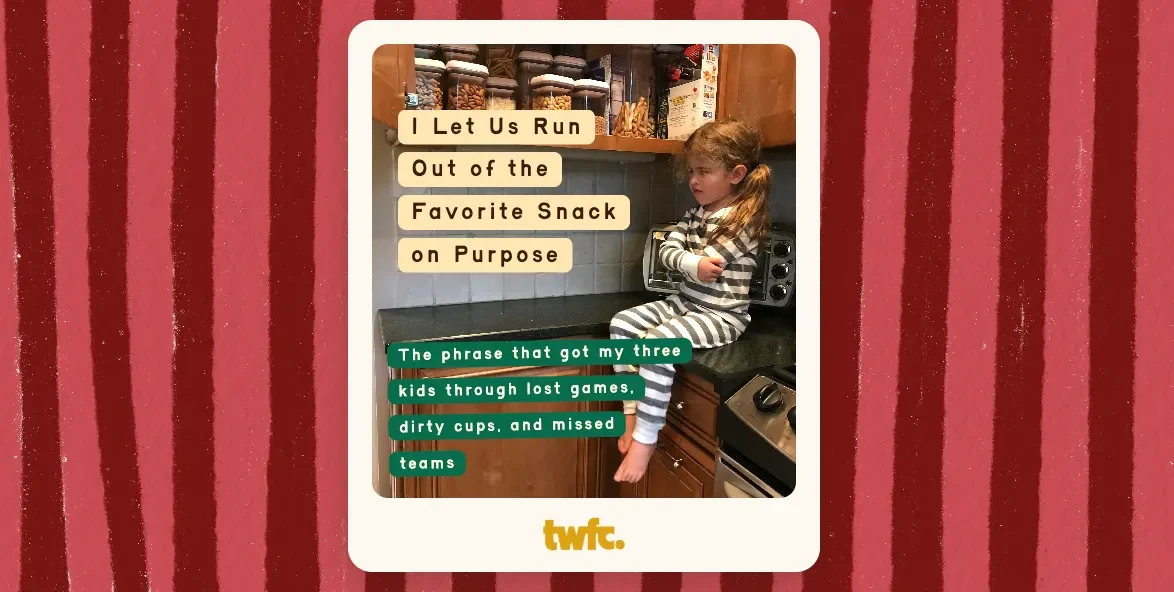
Why I Let Us Run Out of the Favorite Snack on Purpose
the sore loser phase is normal/ making a second choice, the phrase that got my three kids through lost games, dirty cups, and missed teams/ my exact words from toddler to high school

A little over a year ago, my son, Nate, lost a race he was favored to win. He’s a 2-time All-American in the 5k and a State Champion in the 2-mile, and this was one of the final races of his high school career.
People were watching.
He was up against a younger, less experienced runner who pushed hard, and in the last stretch, Nate lost by a tenth of a second. Everyone was shocked. The crowd around the finish line hushed. I squeezed my eyes shut for a second and held my breath a little.
As I opened them, I saw Nate walking right over and congratulating the other kid.
It wasn’t performative. You could see it in his face and in the way his body relaxed into the moment. He was truly impressed by this younger, less experienced runner who out-kicked him at the line.
Later, in a private moment, when other kids might’ve fallen apart:
Me: “You okay? That was pretty wild.”
Nate, shrugging his tan, muscular shoulders: “What an experience. He out-strategized me. I wasn’t expecting that. Good for him.”
He didn’t sulk or beat himself up, and there was no spiraling. He talked about what he learned racing this kid, and how he’d run a different strategy next time. Then he shrugged and moved on.
That was June of 2025. He’s at Purdue now, running D1 in the Big Ten.
When I shared this story on IG, so many parents reached out to me with some version of the following messages:
“How did you raise him like that?”
“At six, my kid is a sore loser. This is goals for high school.”
“My child would have absolutely lost it. How can I help them?”
I’ve spent a lot of time thinking about his childhood, all that unstructured time to play and tinker, and how it shaped who he is today. He built that resilience little by little, in the messier, earlier years. AND some of it is just his innate temperament and personality.
There were times we let him lose without fixing it.
Of course we comforted him. But we didn’t rush to make it better. We tried to be just as present in his losses as we were in his wins, and disappointment got to be part of the experience.
And just so we’re clear, I didn’t figure this out overnight. I’m a former teacher, and I’ve spent years learning how to support kids through their emotional development. Even now, as a parent of three, I still mess it up sometimes (often). If this doesn’t come naturally to you, you can learn it.
Below:
The questions that hand a stuck little kid some power back (the fallen building, the wet pants, the sister who won’t share)
“Making a second choice,” the phrase we used for years, with my exact words for closed screens, the dirty purple shirt, and the last of the milk
The yogurt pouch story from nursery school pickup, and why running out on purpose instead of by accident kept me calm through the fallout
What to say at every age: the lost board game, the empty ice cream carton, the missing hair tie, the A team cut, and the bad grade
How to catch your own spiral before you respond, and the times I accommodate anyway
These are the words I used in my own house, toddler through high school. A free week gets you all of them and every other paywalled post in the archive. Use this Free Seven Day Trial
The rest is for my paid subs.